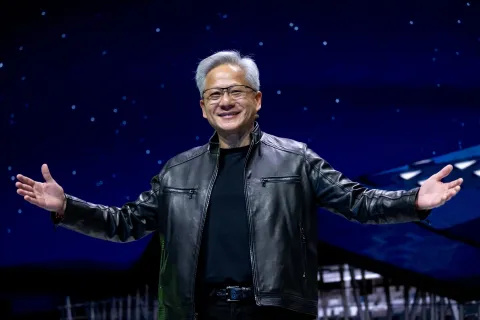
What Jensen Huang did by appearing alongside Ro Khanna at Stanford was not merely declaring support for a tax. It was a calculated act of dissent within his own class.
While Zuckerberg, Larry Page, and Sergey Brin migrate to Nevada and Florida to escape a one-time 5% tax on California billionaires' wealth, Nvidia's CEO stands firm and even invites others to stay. With an estimated net worth of $167 billion, the bill for him would exceed $8 billion in a single stroke, and he still says he hasn't thought about it even once.
There is something deeply revealing in this posture. Huang is not performing charity or staging humility. He is saying, in quite pragmatic terms, that the Silicon Valley ecosystem is worth more than any tax break. "We work in Silicon Valley because that's where the talent pool is," he said. It is the argument of an industrialist who understands that his company is not a portable balance sheet, but an organism rooted in a specific place, in a network of universities, engineers, and a culture of innovation that cannot be rebuilt in Miami.
The contrast with the figures who fled is philosophically interesting. The exodus of Zuckerberg and Google's co-founders exposes an essentially extractive vision of wealth: accumulate where the environment is favorable, and leave when the bill arrives. Huang represents a different vision, closer to a capitalism that still recognizes itself as part of a social contract.
The reaction to Khanna's Roosevelt-invoking tweet was fierce: a venture capitalist launched a primary challenge against him, Eric Schmidt funded a super PAC to block the tax, and even Governor Newsom came out "adamantly" against the measure. In that context, Huang's appearance is not neutral — it is a political act that challenges the narrative that all tech billionaires share the same interests and the same instincts.
The article's second theme, on AI and employment, is where Huang is on his most comfortable ground. The radiologist example is illuminating: Geoffrey Hinton predicted in 2016 that AI would replace the profession, and technically he was right — AI has permeated every aspect of radiology. Yet the number of radiologists increased. The distinction Huang draws between the *purpose* of a job and the *tasks* that comprise it is genuinely useful, and rarely articulated so clearly by anyone in the industry. That said, it would be naive to apply it universally without acknowledging that not every profession has the same elasticity as specialized medicine.
At its core, the article portrays a peculiar moment: the man who profited most from the AI boom is also the one most openly challenging his peers to pay taxes and to stop catastrophizing about the future of work. There is a certain comfortable irony in that, but also a message worth taking seriously.






What Jensen Huang did by appearing alongside Ro Khanna at Stanford was not merely declaring support for a tax. It was a calculated act of dissent within his own class. While Zuckerberg, Larry Page, and Sergey Brin migrate to Nevada and Florida to escape a one-time 5% tax on California billionaires' wealth, Nvidia's CEO stands firm and even invites others to stay. With an estimated net worth of $167 billion, the bill for him would exceed $8 billion in a single stroke, and he still says he hasn't thought about it even once. There is something deeply revealing in this posture. Huang is not performing charity or staging humility. He is saying, in quite pragmatic terms, that the Silicon Valley ecosystem is worth more than any tax break. "We work in Silicon Valley because that's where the talent pool is," he said. It is the argument of an industrialist who understands that his company is not a portable balance sheet, but an organism rooted in a specific place, in a network of universities, engineers, and a culture of innovation that cannot be rebuilt in Miami. The contrast with the figures who fled is philosophically interesting. The exodus of Zuckerberg and Google's co-founders exposes an essentially extractive vision of wealth: accumulate where the environment is favorable, and leave when the bill arrives. Huang represents a different vision, closer to a capitalism that still recognizes itself as part of a social contract. The reaction to Khanna's Roosevelt-invoking tweet was fierce: a venture capitalist launched a primary challenge against him, Eric Schmidt funded a super PAC to block the tax, and even Governor Newsom came out "adamantly" against the measure. In that context, Huang's appearance is not neutral — it is a political act that challenges the narrative that all tech billionaires share the same interests and the same instincts. The article's second theme, on AI and employment, is where Huang is on his most comfortable ground. The radiologist example is illuminating: Geoffrey Hinton predicted in 2016 that AI would replace the profession, and technically he was right — AI has permeated every aspect of radiology. Yet the number of radiologists increased. The distinction Huang draws between the *purpose* of a job and the *tasks* that comprise it is genuinely useful, and rarely articulated so clearly by anyone in the industry. That said, it would be naive to apply it universally without acknowledging that not every profession has the same elasticity as specialized medicine. At its core, the article portrays a peculiar moment: the man who profited most from the AI boom is also the one most openly challenging his peers to pay taxes and to stop catastrophizing about the future of work. There is a certain comfortable irony in that, but also a message worth taking seriously.